The Case for Change
Rural Decline Is Not One Problem
Rural communities rarely decline because of one event. Population loss affects schools, businesses, housing, services, and the ability to maintain community assets. Those changes can make a community less able to attract and retain people, creating conditions that contribute to further decline.
The problems become connected. So does the case for investment.
West Virginia provides a particularly visible example. Population decline, school closures, housing challenges, and uneven access to economic opportunity are occurring at the same time. Understanding how those conditions interact is the starting point for understanding why Agape's work is designed as a system rather than a collection of separate programs.
These pressures extend beyond West Virginia. Rural America as a whole has recently experienced modest population growth, but that recovery has not been evenly distributed. More than half of nonmetropolitan counties still lost population between 2020 and 2024, while growth has been concentrated disproportionately in places near metropolitan areas and communities with recreation-based economies.
That matters because rural decline is neither universal nor inevitable. Different communities face different combinations of challenges and opportunities. Agape begins in West Virginia, but the questions being tested here, how housing, economic opportunity, community assets, connectivity, and population interact, extend well beyond the state's borders.
West Virginia's housing challenge cannot be understood simply by counting vacant homes. A community can have a substantial number of vacant properties and still lack enough housing that is affordable, in adequate condition, the right type, and actually available to the households who need it.
The 2025 West Virginia Housing Needs Assessment found a general lack of housing supply across the state and insufficient affordable and available housing for lower-income households in every region. At the same time, more than 143,400 West Virginia households are housing cost-burdened, including more than 67,500 households spending over half of their income on housing.
Vacancy therefore does not necessarily represent housing supply. A vacant property only becomes part of the solution when it can become housing people can actually use and afford.
Housing and Economic Opportunity Depend on Each Other
Housing Can Be Vacant and Still Be Unavailable
What the Numbers and Research Tell Us
Housing and economic opportunity are often treated as separate development challenges, but each affects the other. Employers need workers who can live within practical reach of their jobs, while households need access to employment that can sustain the cost of where they live.
The 2025 West Virginia Housing Needs Assessment identifies this imbalance directly, noting that housing availability can affect employers' ability to recruit and retain workers. A community can struggle to attract jobs because it lacks appropriate housing while struggling to attract housing investment because it lacks enough economic activity.
This creates a difficult question for rural communities: which comes first, the people, the housing, or the economic opportunity?
Agape's answer is that they have to be developed in relationship to one another.
Reinforcing cycles are not inherently negative. The same relationships that allow one problem to intensify another also create opportunities for one improvement to strengthen the next.
A vacant property returned to productive use can create housing or economic activity. Stable housing can make it easier for people to maintain employment. Employment brings income into households and communities. Local spending can support businesses. Productive community assets can make additional investment easier to justify.
No single investment has to solve every problem. It becomes more valuable when it creates conditions that help the next solution succeed.
This is the opportunity Agape sees in rural communities: not communities without problems, but communities where existing people, properties, infrastructure, knowledge, and relationships can become the starting point for renewed investment.
Disinvestment Can Reinforce Disinvestment
The Cycle Can Move In the Other Direction
The case for investing in rural community stability, starting with housing, is not built on compassion alone. It is supported by evidence.
People living and working in a community are often the first to understand what is happening there. Research and data provide another perspective, helping identify broader patterns, test assumptions, and measure whether an intervention produces the results people hoped it would.
Existing research and real-world programs also give Agape a place to begin. They show what others have tried, what happened, what it cost, and what questions remain unanswered.
Agape uses evidence to inform the work, people to ground it, and results to determine what comes next.
School Closures Are a Systemic Symptom That Rarely Has One Cause
A school closure can result from many interacting pressures, including declining enrollment, financial constraints, facility conditions, policy decisions, management choices, and changing community needs. The combination will differ from one community to another.
But closures also become part of the system around them. Families may face longer travel, communities lose gathering places and public infrastructure, and buildings that once represented substantial public investment can become vacant liabilities.
West Virginia shows how quickly that pattern can accelerate. In 2020, state facility plans projected that approximately 60 schools could close by 2030. By 2026, 58 of those 60 schools had already closed. This is not an example of government giving up. It is an illustration of how these pressures affect one another.
A school closure may be the result of several problems. Once it happens, it can also contribute to the conditions a community must overcome.
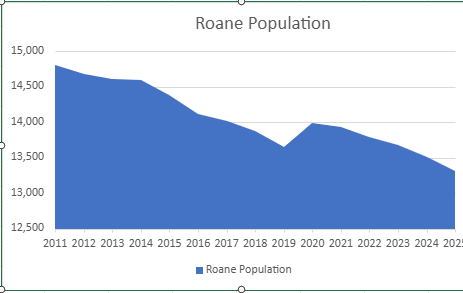
Roane County illustrates how sustained population loss changes what a community can support. As the number of residents declines, the same schools, businesses, infrastructure, and public services must operate with fewer people to sustain them.
Roane County's population has declined over time, and the brief increase shown in 2020 reflects the decennial Census count rather than a reversal of the broader trend.
Population loss is not simply fewer people. It changes the economic and institutional foundation the remaining community depends on.
Population Loss Changes What a Community Can Sustain
Investment decisions do not happen in isolation either. When businesses, developers, lenders, and other investors see little activity in a community, investing there can appear riskier. When fewer people invest, properties may deteriorate, opportunities remain undeveloped, and there is even less evidence that new investment will succeed.
The result can become a cycle: lack of investment contributes to the very conditions that make future investment harder to attract.
Breaking that cycle does not necessarily require one organization to rebuild an entire local economy. Sometimes it begins with enough investment to put an existing asset back to work, demonstrate that something can succeed, and give the next investor a reason to look again.
Changing a community's trajectory sometimes requires creating movement where investment has stalled.
When Missing Rent Does Not Mean a Household Cannot Recover
Not every missed rent payment represents the same problem. Research published by the National Bureau of Economic Research examined nearly 6,000 tenancies in low-income rental markets and found that falling behind was common, but recovery was common too.
Among tenants who fell behind, 39% eventually resumed paying and repaid all of their overdue rent. Even among tenants who were evicted, researchers estimated that 15% would have returned to sustained rent payment had the eviction not occurred.
Eviction carries costs for property owners as well. The researchers estimated that landlords behaved as though beginning an eviction cost the equivalent of approximately two to three months of rent.
The research does not suggest that every eviction can or should be prevented. It suggests something more useful to Agape: temporary disruption and persistent inability to pay are not the same problem, and targeted intervention may matter when recovery is possible.
Stability Can Change More Than Housing
Housing First programs provide people experiencing homelessness with access to permanent housing without requiring them to first complete treatment or meet other conditions. The population, services, and intervention differ substantially from Agape's work. The research is relevant here for a narrower reason: it provides an example of what can happen when housing stability itself becomes an earlier point of intervention.
A systematic review of randomized trials found that Housing First participants were about 2.5 times as likely to be stably housed after 18 to 24 months as people receiving usual services. Participants also experienced fewer emergency department visits and hospitalizations.
The economic evidence is more nuanced. Housing First requires substantial investment, and research does not show that every program completely pays for itself through reduced public costs. However, studies have documented significant offsets through reduced use of shelters, emergency departments, and other services.
Housing First does not prove Agape's model will work. It demonstrates a principle worth examining: changing the point at which support enters a system can change both human outcomes and the costs that occur elsewhere in that system.
Can investing in people's financial stability also make economic sense for the organization making the investment?
When Investing in People Becomes a Business Decision
In 2015, Gravity Payments made a controversial decision. The small payment-processing company announced that it would raise its minimum employee salary to $70,000 over three years. The decision drew national attention, criticism, employee concerns, customer losses, and predictions that the company would be unable to sustain it.
The experiment did not produce a perfect story, but it survived. In the years that followed, Gravity reported substantial business growth and lower employee turnover. By 2021, the company had roughly doubled its workforce and reported that employee turnover had fallen by about half.
Perhaps more importantly, the policy eventually faced a test that had little to do with wages. Gravity changed leadership in 2022. The compensation model continued under the company's new CEO, and a decade after the original announcement Gravity was still operating with the higher-wage philosophy in place.
Gravity Payments does not prove that paying people more will always produce a financial return. It demonstrates something narrower and more useful: an investment in people's financial stability that appeared economically risky could coexist with business growth and survive beyond the leader who introduced it.
Investment and Rural Growth Move Together
Rural communities are sometimes discussed primarily in terms of what they lack. A 2026 analysis by the U.S. Department of Agriculture looked at the question from another direction: what happens in rural counties where more investment actually occurs?
USDA researchers examined Rural Development investments across rural counties from 2000 through 2024. Counties receiving the least investment per person experienced average real per-capita income growth of 31.8% over the period. Growth increased across each successive investment group, reaching 39.9% among counties receiving the highest investment per person.
The researchers do not claim that Rural Development funding caused the difference. Many other characteristics can influence both investment and economic growth. What the data show is an association: rural counties receiving greater investment also experienced greater growth in real income per person.
That distinction matters to Agape. The evidence does not justify assuming that putting money into a rural community will automatically produce a return. It does challenge the assumption that rural investment and economic growth are incompatible. The question worth testing is what kinds of investment, under what conditions, help create the strongest return for people and communities.
The Evidence Points Toward a Question Worth Testing
None of this research proves that Agape's particular model will work. The studies examine different populations, interventions, organizations, and places. What they provide is evidence that the relationships Agape wants to test are plausible.
Temporary financial disruption does not always become permanent failure. Earlier intervention can change downstream outcomes and costs. Investment in people's financial stability can coexist with organizational growth. And across rural communities, greater investment has been associated with greater growth in real income.
Taken together, the evidence gives Agape a reason to test a simple proposition: when investment is designed around people, existing assets, and the relationships between them, can one improvement help create the conditions for another?
Agape intends to find out by building carefully, measuring what happens, listening to the people involved, and changing the model when the evidence requires it.